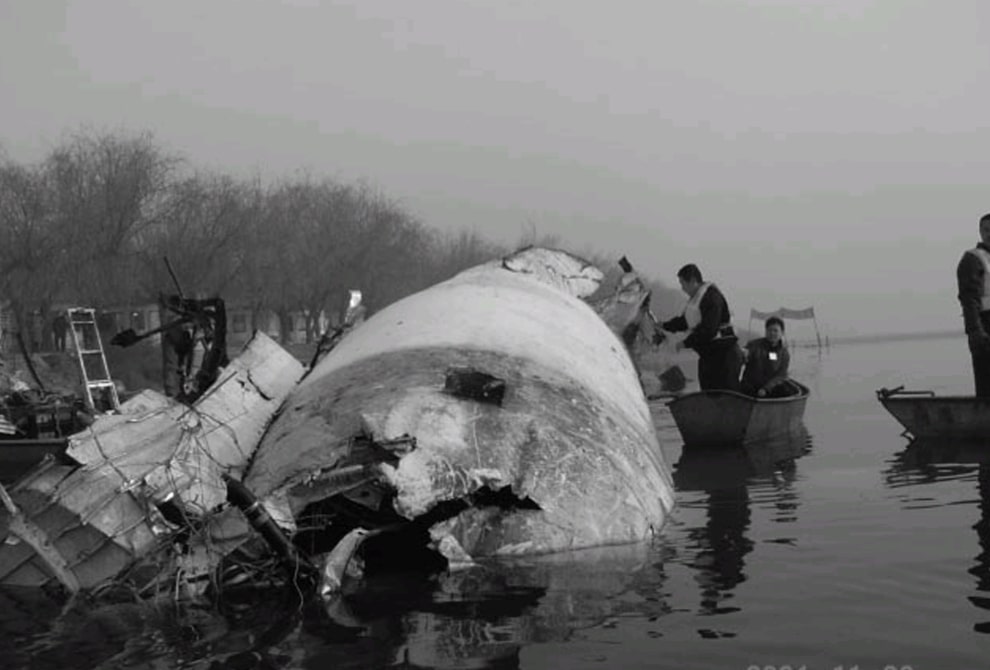
More than four years after a Boeing 737-800 passenger jet plunged 29,000 feet and crashed into a mountain in southern China, killing all 132 people on board, newly released data appears to indicate that someone in the cockpit may have intentionally switched off the fuel supply to the engines.
It was China’s deadliest air disaster in decades, but the Civil Aviation Administration of China (CAAC) has not addressed the crucial question of what prompted the deadly nosedive of China Eastern Airlines Flight MU5735 in March 2022 in the remote Guangxi region.
Data released by the National Transportation Safety Board (NTSB) in response to a Freedom of Information request shows that the fuel switches to both engines were shut off simultaneously before the Boeing 737-800 jet fell from the sky.
The data was taken from the plane’s flight data recorder — one of two so-called “black boxes” that record relevant operational information — which was recovered from the wreckage and sent to the NTSB laboratory in Washington, D.C., for analysis. The agency became involved because Boeing is a US aircraft manufacturer.
“It was found that while cruising at 29,000 feet, the fuel switches on both engines moved from the run position to the cutoff position. Engine speeds decreased after the fuel switch movement,” the NTSB report stated.
Fuel switches on commercial aircraft are physical controls that regulate the flow of fuel to the engines. On the Boeing 737, a pilot must pull the switch upward before moving it from the run position to cutoff.
“This data clearly shows that the fuel switches were manually placed in the off position just prior to the crash,” said David Soucie, a CNN aviation safety analyst.
“There is no indication the switches were placed back in the on position. That suggests there was no attempt to restart the engines,” he added. “If the switches had been turned off accidentally, the pilots would likely have attempted to turn them back on.”
According to the report, the flight data recorder stopped recording when the plane’s generators lost power at 26,000 feet and did not capture the aircraft’s final moments. However, the cockpit voice recorder — the plane’s second “black box” — continued recording through a battery backup.
US investigators reportedly recovered four voice recordings from the damaged cockpit recorder and sent them to the CAAC, though the NTSB said it did not retain copies of the audio files.
CNN has reached out to both the CAAC and China Eastern Airlines for comment. The CAAC has previously denied that the crash was intentional.
Source: CNN


